Farewell Doug Mirabelli

mirabelli.jpgDougMirabelli had the best timing of any backup catcher in the history of
major league baseball. He joined the Sox in the middle of the 2001
season, as the team hurtled towards its 83rd straight year of
unfulfilled hopes, then celebrated a joyfully apocalyptic championship
in 2004 and another for good measure in 2007. Upon his release
yesterday, he left the Red Sox as one of only eight players who played on both championship clubs.

I’m a sentimental baseball fan, so I was truly saddened to hear the
Sox had let Mirabelli go. But I trust Theo and Terry and I’m sure it
was the right thing for the team.

What never ceases to surprise me, however, is how easily fans and
media let someone like Doug Mirabelli just slide out of sight. He’ll
get a short article in the Herald and Globe that will be
primarily about how important Varitek is to the team, and the callers
to our sports talk show radio stations today will say, "Doug was overweight and slow, and he couldn’t hit a lick, good riddance!" We
obsess over these players and cheer for them like crazy, then when
their usefulness is spent, we discard them like old cell phones.

I realize that every professional baseball player’s career must come
to an end, and that they always come to an end while the player is
relatively young (Doug is 37, and in the whole scheme of
things, that is young). I realize that turnover in baseball is
inevitable – and, ultimately, desirable. I realize that Mirabelli’s
batting average dipped to .202 last season and would probably have
dipped below the Mendoza Line this season. I’m not saying that
releasing him was not a smart move.

But let’s give the guy his due. He was the only player capable of
catching Wakefield’s wicked knuckleballs. He hit some dramatic, key
home runs as a member of the Red Sox. He accepted his backup role with
grace and appeared to be a good teammate, too. And most importantly, he
was our backup catcher during the greatest era in Boston Red Sox
history since the early 20th Century.

The former baseball commissioner A. Bartlett Giamatti once wrote, "The
game breaks my heart because it was meant to, because it was meant to
foster in me again the illusion that there was something abiding, some
pattern and some impulse that could come together to make a reality
that would resist the corrosion…"

"Of course, there are those who were born with the wisdom to know
that nothing lasts. These are the truly tough among us, the ones who
can live without illusion, or without even the hope of illusion. I am
not that grown-up or up-to-date. I am a simpler creature, tied to more
primitive patterns and cycles. I need to think something lasts forever."

mirabelli-and-kapler-on-duck-boat-2004.jpgI’m
like Bart. There’s a part of me that wants to believe the illusion that
that 2004 team can last forever; that the Wake and Dougie battery will
be there every fifth day for eternity. And that part of me died a small
death yesterday with the news of Mirabelli’s release. Of course, for
Doug Mirabelli himself, the news has to be its own unique form of
dying. It’s the end of the most magical period of his life. "Not a lot
of fun for anybody," said Terry Francona about breaking the news to
Mirabelli prior to yesterday’s game.

Fireworks aren’t necessary, nor is the cover of Sports Illustrated.
I get it. He’s not Brett Favre. But how about a heartfelt "standing O"
for our #28? Those members of Red Sox Nation who have the good fortune
of attending the Red Sox’ home opener, on April 8, will get their
chance to applaud Mirabelli’s contributions to this franchise as he is
introduced to receive his 2007 World Series ring (unless he’s playing
for another team by then). Maybe we’ll get to hear Tim McGraw’s "Live Like You Were Dying"
one last time (the poignant song about making the most of every moment
that Mirabelli chose to blare from Fenway’s loudspeakers every time he
came to the plate). If you’re there that day, I hope you’ll cheer long
and loud. Not just for Doug Mirabelli, but for all members of that
great 2004 team who have slipped away silently from baseball; who, in
the end, could not "resist the corrosion."

http://www.box.net/static/flash/widget_player.swf

Get your own Box.net widget and share anywhere!

To download my song I’m a Member of Red Sox Nation for free, or to see the YouTube music video for this song, visit www.crawdaddycove.com.

Got Tickets?

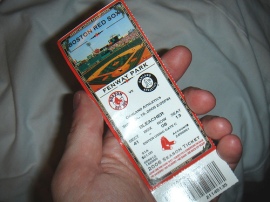
red-sox-ticket.jpgAticket to a Red Sox game. There?s nothing quite like holding one in
your hands. It?s that sublime feeling of knowing a Fenway Park
experience lies in your future. The anticipation is palpable.
Regardless of whether the Sox eventually win or lose, with a ticket to
a game, you?re guaranteed the thrill of watching Big Papi and Manny
stride into the on-deck circle; the roar of the crowd following a
spectacular defensive play; the majesty of the Green Monster looming in
left field; two choruses of Sweet Caroline and its euphoric chant, ?So
Good! So Good! So Good!? And for many of us, there?s Fenway?s
time-capsule quality that transports us back to our childhoods and
reconnects us with our parents, or the spirits of our parents who have
passed away, and re-ignites in us the joy of being alive.

And this was all true BEFORE the Red Sox ever won a World Series. Now, when we go to Fenway, we get to see the World Champions!

No wonder it?s so hard to get a ticket. Yes, demand for tickets is
through the roof, and the Red Sox continue to price their tickets at
levels well below ?market value? in order to keep a Fenway Park
experience accessible to the ?average fan.? In addition, ticket supply
is low ? we have the smallest stadium in Major League Baseball and 81
home games just isn?t enough to satisfy our fans? hunger. And as any
college professor of economics will tell you, these three forces (along
with complete lack of enforcement of scalping laws) make a ?secondary
market? for tickets inevitable. So that?s what we have in Red Sox
Nation: a robust, flourishing, highly profitable ticket-booth-at-fenway.jpgmarket for Red Sox tickets that have already been sold once by the team.

Almost nobody loves the ticket reselling ("scalping") industry. Yet,
as I see it, there are only a handful of ways the Red Sox could combat
ticket resellers, and almost all of them seem silly:

1) The Sox could price all seats at fair market value. That would mean a ?dutch auction?
for every ticket, which would lead to prices of at least $500 per seat
for every game. Yes, that includes bleachers and standing room only.
This would kill the reselling industry?s interest in Sox tickets
because, theoretically, no ticket would be sold initially for an amount
less than its highest potential bid.

2) The Red Sox could start to lose more games than they win, which would diminish demand.

3) The Red Sox could tear down Fenway and build a stadium with
100,000 seats. This would probably curtail demand (Fenway is an
attraction, regardless of how well the team plays) and also increase
ticket supply.

4) The Red Sox could petition Major League Baseball to play all
their games at home. If they were successful, this would double the
supply of tickets. Likewise, they could petition the league to play 50
home games against the Yankees, to make these tickets less special.

5) The Red Sox could revoke all season ticket holders? seats. Season
ticket holders are currently the biggest supplier of the ?secondary
market? (after all, who has time to attend every home game?) and
putting more tickets back under control of the team would take a huge
bite out of resellers? inventory and would allow the Red Sox to find
more ?unique? fans to sell them to ? fans who would be more likely to
actually use the tickets rather than resell them.

6) The state of Massachusetts could enforce the law against
reselling tickets at more than $2 of their face value. Which, it
appears, will never happen.

Short of these drastic measures, however, there are proactive ways
to combat the reselling industry and get tickets into the hands of
?regular fans,? and the Red Sox use almost all of them. They:

1) Place strict ticket limits on ticket-buying customers (other than
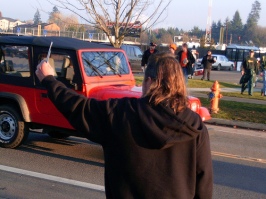
season ticket holders) to ensure a large number of ?unique? buyers.ticket-scalper.jpg
2) Hold several ?random drawings? before and during the season,
which gives lucky fans the right to purchase online highly coveted
Green Monster seats, Right Field Roof Deck seats, Yankee Game seats,
and even playoff and World Series seats. (I have "won" Red Sox email
drawings three times over the years, proving that it really does work.)

3) Host a ?scalp-free zone? outside Fenway, which enables fans to
sell their tickets at face value on the day of the game. Buyers of
these tickets are required to enter Fenway immediately after buying a
ticket, to ensure the tickets don?t get resold for a profit.

4) Sell ?day of game? tickets at Gate E, beginning two hours before game time.

5) Announce the sale of new blocks of tickets at random times before and during the season.

6) Set technological traps to foil resellers in the online ticket-buying process.

Consider this: By keeping ticket prices well below their actual
market value, the Red Sox are effectively offering ?financial aid? to
every person who buys a ticket directly from them. Absurd, you say? Not
really. If the actual value of a particular ticket is $500 on the open
market, and the Red Sox know this yet choose to sell this ticket for
$80, they are purposefully offering financial aid of $420 to the buyer
of that ticket. And they do this for the same reason that Harvard does
it, or Andover, or any other expensive educational institution: because
they don?t want their customer base to consist solely of wealthy people.

There?s a moral angle here, to be sure, but there?s also a long-term business angle. If the Sox were to maximize their profit now
by selling tickets at their actual market value (which would terminate
the secondary market for Sox tickets), the economic diversity of their
fan base would diminish. Consequently, if the team were to hit hard
times in the future (i.e., they begin to lose more games than they win?
uncomfortable to imagine, I know), they would have a difficult time
selling tickets at the exorbitant prices leftover from the glory days
of 2008 and would probably have to slash prices. In addition,
attracting back the millions of fans who were disillusioned by their
lack of access to games might be a major challenge.
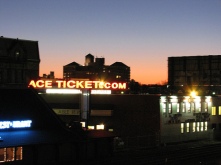
ace-tickets.jpgA
few days ago, the Red Sox signed a sponsorship agreement with Ace
Ticket
and proclaimed them ?the official ticket reseller of the Boston
Red Sox.? Yes, it?s crummy that ANY team has an ?official ticket
reseller,? but to put in perspective how established the ticket
reselling industry is in 2008, keep in mind that Major League Baseball
itself has partnered with StubHub, another ticket reseller, as the
official ticket reseller of Major League Baseball. The entire LEAGUE is
profiting from the ticket reselling industry — it’s not just the Red
Sox.

To the Red Sox? credit, last year they instituted a program called
?Red Sox Replay? that enabled season ticket holders to resell their
tickets online at virtually face value (fans could log on and buy
tickets at a markup of approximately 25%, a small percentage of which
went to the Red Sox for maintenance of the site). But the moment MLB
inked their exclusive deal with StubHub, the Sox were forced to tear
down Replay, since it competed with StubHub?s interests. As Sam
Kennedy, the Sox’ chief Marketing and Sales officer, told The Boston Globe
earlier this week, without Replay, the Sox felt compelled "to identify
and endorse a secure and reputable secondary market option" for their
season ticket holders. 

It?s also important to point out that the Red Sox have not provided
Ace with "tickets for resale" as part of their deal, and the Sox do not
stand to profit from a single ticket that Ace sells. This is a straight
advertising deal – the team is simply accepting a large check from Ace
Ticket for sponsorship (and, we trust, investing this back into the
team on the field), and they have sent a letter to their season ticket
holders recommending Ace Ticket as the team?s reseller of choice.
That?s it.

ticket-line-at-fenway.jpgNow
if Abe Lincoln owned the Red Sox, would he have signed a sponsorship
agreement with Ace? No. What about A. Bartlett Giamatti, the former
commissioner of baseball who was as principled a man as ever lived
(he?s the guy who banned Pete Rose from baseball). Would Bart have
signed a sponsorship agreement with Ace? Probably not. Abe and Bart
would have eschewed any deal that appeared to link their team with
scalpers.

On the other hand, neither of these men were successful businessmen, and neither would ever
have been picked to run a major league baseball team. The Red Sox are
not only our beloved Olde Towne Team, they are a business. ?Good
business? helped us win it all in 2004 and 2007, and good business will
help us win in the future, as well. It?s hard to fault the business
people at the Red Sox for pocketing an easy endorsement check (and
offering a "benefit" for season ticket holders) when not doing
so would (arguably) jeopardize our competitiveness in the American
League East. The money the Sox are making from the Ace Ticket deal
will help them put the highest quality team on the field for 2008 and
beyond. Yup, winning really does have a steep price.

While down here in Fort Myers, I had a chance to talk about all of
this with Ron Bumgarner, Red Sox VP of Ticketing, for about 30 minutes.
And what I?ve concluded is that his job is different from that of every
other VP of Ticketing at every other MLB franchise. While other teams
are busy trying to sell as many tickets as they can at the highest
possible prices, the Red Sox are trying to sell all of their
tickets at a discount (theoretically) to as many unique, regular fans
as is possible, and working assiduously to thwart ticket resellers at
the same time (yes, even though they just advised their season ticket
holders to sell their unused tickets to Ace, the Sox will continue to
try to keep varitek-fan.jpgother individual tickets out of Ace’s and other resellers’ hands). Profit was Ron’s main concern when he ran ticketing for the San Diego Padres, but here at the Red Sox, profit takes a back seat to equitability and wide distribution of tickets across Red Sox Nation’s loyal citizenship.

And you just have to trust me when I tell you that Ron is committed
to keeping Fenway accessible to ?regular fans.? He has a couple of
young children of his own, and I know he relates personally to the
"regular fan" whose parents brought him/her to games at Fenway during
childhood, and now wants to bring his/her kids to the park, too. "It’s
a complicated problem," Ron told me, "But since it means the Red Sox
are winning games, it’s a good problem in the end."Right?

http://www.box.net/static/flash/widget_player.swf

Get your own Box.net widget and share anywhere!

To download my song I’m a Member of Red Sox Nation for free, or to see the YouTube music video for this song, visit www.crawdaddycove.com.
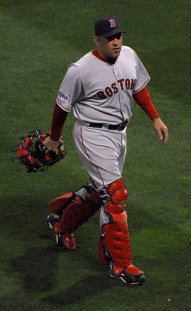
A Father In Baseball Heaven

ted-williams-statue-at-city-of-palms-park-el-swifterino.jpgYouwant to have a magical Red Sox experience in Fort Myers? You want to go to a place where the players are so close, they walk right past you and even say good morning?  You want to give your kids a chance to
fill a couple of baseballs with autographs? You want to watch the
players stretch, play long-toss, practice pick-offs and and run-downs,
and hear everything they say? You want to mingle with Red Sox legends?

Forget going to City of Palms Park, where the team that’s
Boston-bound practices and plays. The crowds there are so huge, you can
hardly blame the major leaguers for hiding in the batting cages out
back. Instead, head down Edison Avenue about three miles, all the way
to the end, to the Red Sox’ Minor League Complex. This morning, I
strolled in there with two of my kids at 9:30am (admission is free),
and for the next two hours, we (and the 30 other fans there) were in
baseball heaven. Seriously.

As the players emerged from the locker room, every single one of
them stopped to sign an autograph for my boys (ages 8 and 6) and to say
hello. Most of the players are guys you’ve never heard of, but among
them were notablspring-training-autographs.jpge prospects Michael Bowden, Justin Masterson, and Joshua Papelbon, and former major leaguers Tom Goodwin and Billy McMillon.
Did my kids even CARE who they were? Of course not — they were just
thrilled to see pro ball players in Red Sox uniforms up close. VERY
close.

The players split up into about six groups and headed out to six
different fields to stretch and go through their daily drills. From the
center of the complex, you can see all six fields, though it’s more fun
to pick one field and study a subset of players. My boys and I brought
our gloves and a ball, and on the lawn between fields, we tossed the
ball to each other, practicing our fly balls and grounders, playing
monkey in the middle, and just having a grand old time pretending we,
too, were getting ready for the season. Which we were! (Me as a fan,
and my boys as little leaguers.)

A groundskeeper driving past us in his golf cart stopped and handed
a broken bat to each of my children. The bats had the words "Boston Red
Sox" engraved on the barrels. Think they’ll ever forget that?

spring-training-broken-bats.jpgMy 8 year-old is savvy enough to know who Dwight Evans
is, so when I pointed out Dewey to him as he walked from one field to
another, my son ran over and politely asked him to sign his hat. #24
was more than happy to oblige, and he signed my 6 year-old’s hat, as
well. "He’s one of the greatest right fielders of all time," I told my
kids as they gazed at their new autographs. "Lots of people say he
should be in the Hall of Fame."

Tommy Harper was there, too. And **** Berardino. And Frank Malzone.
All of them walking among the handful of fans who were there and all of
them pleased as punch to sign an autograph for a kid or pose for a
photo.

At one point, while watching players practice first-and-third
double-steal coverages, a toddler who was near me started to cry
loudly. One of the Red Sox catchers involved in the drill trotted over
with a baseball, gave it to me, and said, "Give this to the kid, it
should stop the crying." I made the delivery and, he was right, the
tears turned to smiles.

At 11:30am, we left the minor league complex and drove down the
street to watch the big leaguers play in a 1pm game versus the New York
Mets. We had a splendid time and the boys loved starting the "Let’s Go
Red Sox!" cheers and clapping for Manny and Youk every time they
stepped to the plate. But the game will probably fade quickly from
their memories. Afterwards in the car, all they could talk about was
their exciting morning among the minor leaguers and former pros, and
when they called Grandma to tell her about the day, that’s what they
raved about. "I met Dwight Evans! And you know what? The minor leaguers do the same drills we do in little league! Can you believe it?"

I think you understand. Today I was a father in Baseball Heaven.

It’s A Red Sox Universe II

Young_sox_fansI have no doubt that my Red Sox childhood (which really began in 1976, when I was 7) was enhanced by the existence – and personality – of George Steinbrenner. (And Billy Martin and Reggie Jackson, for that matter.) Red Sox Universe is an epic, and every epic needs a legitimate villain. I have to admit, I didn’t even notice that Red Sox Universe was starting to get slightly bland until George’s son decided to speak his mind. I agree with Dan Shaughnessy, who writes in today’s Boston Globe, "Hank is definitely going to be good for the rivalry," and "Having Hank on board is certainly a beautiful thing."

Buzzemperorzurg1
What would Oz be without the Wicked Witch of the West? What would Neverland be without Captain Hook? What would the Galactic Republic be without Jabba the Hutt and Darth Vader? What would Buzz Lightyear’s Intergalactic Alliance be without Emperor Zurg? What would Dora the Explorer be without Swiper the Fox or the Troll? (Those last couple of metaphors are targeted to Red Sox Kid Nation, five of whom I spend all my time with every weekend, at home.)

I’m so happy for my kids that there’s another Steinbrenner running the Yanks. Every kid in Red Sox Universe deserves a full-blown, emotionally charged rivalry, and Hank promises to inject that element we didn’t even know we craved.

Does Hank have kids that will take over in 20 years? Is there a chance this epic drama could extend to my grandchildren’s Red Sox childhoods? I certainly hope so.

The Red Sox Go To Washington

ortiz-and-trophy.jpgBeing Vice President of Red Sox Nation is like being dropped into an alternative universe where you wake up some mornings and say, "I had the craziest dream," and then you realize, it wasn’t a dream at all, and whatever dreams I DID have couldn’t have been as wild as the reality.

Today will go down as one of those days. I woke up in my bed in Boston, left my five children and wife sleeping to catch a 7am flight to Washington, D.C., drove to the Supreme Court building where Red Sox Nation President Jerry Remy and I were officially sworn in by Justice Stephen Breyer in his chambers during his short break from a hearing on the Exxon Valdez case (with Larry Lucchino and John Henry at our side), drove over to the White House for a tour with Red Sox owners, front office personnel, and members of their families, then went outside to join over 1,000 members of Red Sox Nation on the South Lawn, sitting in the second row behind Ted Kennedy and John Kerry, to see the Red Sox line up behind President George W. Bush for a special ceremony honoring the World Champions. Unfortunately, I wasn’t able to join the team when they visited Walter Reed Memorial Hospital after the White House visit, but I hear it was quite a memorable and meaningful experience for the players and the patients.

As for the part of the day I was privileged to be involved in, I’ll let the photos speak for themselves.

Crawford_remy_breyer_henry_lucchino_2270

Crawford_and_remy_2_at_supreme_court_227_2

The Vice-President and President of Red Sox Nation leave the Supreme Court after being sworn in by Justice Breyer (a die-hard Sox fan). Our pledge: "I, Gerald Peter Remy [and Robert Crawford], do solemnly swear that I will faithfully execute the Office of the President [and Vice-President] of Red Sox Nation. I pledge to be true to the game, true to our fans, and to the best of my ability preserve, protect and promote all that is great about the beloved sport of baseball and the Boston Red Sox."

Abraham_lincoln_portrait_in_white_house

Regardless of your politics, it’s pretty humbling to walk through the White House and think about the fact that Abraham Lincoln (whom you KNOW would have been a huge baseball fan) lived in and directed the Civil War from there.

rsn-gathers-on-south-lawn-view-from-blue-room.jpg

Red Sox Nation congregates on the South Lawn. This photo was taken from inside the Blue Room during our tour of the White House, about 45 minutes before the ceremony with the team.

white-house-and-rsn-2-27-08.jpg

Rsn_awaits_the_president_on_south_lawn_2

John_kerry_and_mike_barnicle_on_south_la

More than 1,000 members of Red Sox Nation await the arrival of the World Champion Boston Red Sox and the President and Vice-President of the United States — including Senator John Kerry and writer Mike Barnicle (who, when he writes about baseball, is just about the best baseball writer there is).


pap-cora-kielty-drew-crisp-lugo.jpg

Ortiz_brings_the_trophy_2_3

bush-with-henry-and-pap.jpgbeckett.jpg

snyder-timlin-pedroia.jpg

cheney-and-sox.jpg

lowell-kielty-lugo.jpg

bush-and-tek-2.jpgellsbury.jpglucchino-mirabelli-wake-youk-beckett.jpgbush-and-drew.jpgremy-and-kennedy.jpg

lester-daisuke-buchholz-schill.jpg

Bush_and_beckett2

Bush_and_kielty

Bush_and_ortiz

Bush_and_youk

Papelbon

Bush_and_tek

Rob_with_rskn_members_on_south_lawn

This is me with a couple of loyal members of Red Sox Kid Nation from Kensington, Maryland who got there early and were right up front — Quentin and Bryce Auster. What a blast for all of us who had the good fortune of applauding the Sox at the White House!

The_brick_22708_1 Back at Logan Airport after the trip to D.C., we were pleasantly surprised to be greeted by members of the United Airlines staff, who had confiscated our historic Fenway Park brick while going through security in the morning. We had wanted to use the brick for the swearing-in ceremony, but instead, Rem Dawg and I placed our left hands on an Offical Major League Baseball, imprinted with a gold Red Sox logo, that Justice Breyer had sitting on his desk. (Like I said, he’s a true fan.) Pictured here are Michael Castro (United Airlines), Mardi Fuller (Red Sox), Regular Rob, Debbie Neal (United Airlines), and Joe Januszewski (Red Sox).

Quotes of the day:

1. From Red Sox Vice President Chuck Steedman, next to whom I sat at lunch in a White House dining room: "They don’t do this [fun stuff] for teams that come in second."

2. From George Bush: "I see Manny’s not here. I guess his grandmother died again. Just kidding. Tell Manny I didn’t mean it. But I do want to quote him. He said, "When you don’t feel goocheney-bush-pap-lowell.jpgd, and you still get hits, that’s when you know you’re a bad man." (Laughter.) I don’t know what that means. (Laughter.) But if bad man means good hitter, he’s a really bad man."

3. From George Bush: "Red Sox Nation extends beyond the South Lawn, extends beyond New England — it obviously goes to the Caribbean and even the Far East. So we welcome Japan’s Daisuke Matsuzaka here to the South Lawn. His press corps is bigger than mine. And we both have trouble answering questions in English."

For the full text of Bush’s speech (it was pretty good, actually), click here.

And certainly, one of the great highlights of the day was getting home in time to tuck in my 8 year-old son and present to him a ball autographed by Josh Beckett: "AWESOME, DADDY!" and to tuck in my 5 year-old son and present to him a ball with George Bush’s autograph imprinted on it: "This is perfect, Daddy, since I don’t really like baseball, but I really like famous people! And clean baseballs!"

http://www.box.net/static/flash/widget_player.swf

Get your own Box.net widget and share anywhere!

To download my song, I’m a Member of Red Sox Nation song for free, or to see the YouTube music video for this song, visit www.crawdaddycove.com.

What I Love About Baseball

baseball-bats-and-batting-glove.jpgThe leathery-dirt smell of a Rawlings baseball glove. The feel of a high-seamed baseball under my fingertips. Kids imitating their heroes’ batting stances. Defensive replacements in the 9th inning. The allure of an expansive green lawn. The thwack of a fastball slamming into a catcher’s mitt. Luis Tiant. The count. Inches. Emphatic umpire’s calls. Outfielders throwing bullets over long distances to a precise point in space. The pivot at second base. Stealing third. A catcher nailing a would-be base-stealer at third. Acrobatic centerfielders. Baserunners flying at full speed at the crack of the bat, with less than two outs, knowing the line drive will drop in. Earl Weaver. Fielders balanced on the balls father-and-boys-outside-fenway.jpgof their feet as the pitch is delivered, imagining infinite possible outcomes. It’s every day. The black of the plate. Jason Varitek. No-hitters. Extra infield work. Broken-bat singles that end a slump. A perfectly executed suicide squeeze. A totally botched suicide squeeze. Anticipation and hope in the bottom of the ninth inning. Peter Gammons’ old baseball columns in the Sunday Globe. Big league dreams in the imagination of a nine year-old. The scoop at first base. A pick-off at second base, in slow motion. Taking the first pitch, all the way. Taking the 2-0 pitch, all the way. Purposefully moving the runner over. Catchers who frame the pitch just inches off the plate, and umpires who don’t fall for it. Jackie Robinson. Two-out RBI hits by the player the pitcher preferred to face, following an intentional walk. Meaningless chatter when managers visit pitchers on the mound, and umpires who go out to "break it up" after ten seconds. Dewey nailing a baserunner at third. Batters who sprint to first base after getting drilled in the back, expressionless. Stealing home. Catchers who back-up first base. Curt Schilling in the post-season. A 3-2 change-up….three times in a row. Grown men playing a child’s game. The Red Sox. Players who talk to, smile at, or wink at fans while in the on-deck circle. Catchers who block the plate, and baserunners who barrel into first-base-line.jpgcatchers blocking the plate. Old men and women who keep score, every game. The marvelous sensation of my bat connecting with a ball on the sweet spot. Listening to the game on the radio – in my car, in my kitchen, on the beach. Take Me Out To The Ballgame. Fenway. Wrigley. Eliot Playground in Brookline. Hot dogs. Kids who wear their gloves in the stands and expect to catch a foul ball. Putting on a baseball cap and transforming into myself. Pennant races. Dr. Charles Steinberg’s "Path of the Fan Experience." Pitchers who use numerous arm angles. The knuckleball. Baseball Tonight on ESPN. The expression on a kid’s face when he/she walks up the ramp into a major league baseball stadium for the first time. Cal Ripken. Poring over the sports section, 365 mornings a year. Fathers and mothers playing catch with sons and daughters in the driveway. Hitting fungos to my brother on a 90-degree day…. just one more. Rem Dog’s astute color analysis. The first practice of the little league season, when kids get their t-shirts and begin to bond with their uniform number. Tommy Lasorda. Sunflower seeds. Eye black. Pitchers who show no emotion. Overly emotional pitchers. Batting averages. Box scores. When the home team trots onto the field in the top of the first inning. Francisco Cabrera and Sid Bream. Grown men and women wearing shirts with the names of their favorite players on the back. Ticket stubs in my little-leaguer-1976-photo.jpgfather’s mirror over his dresser. Kids seeing "the wave" for the first time. Fans high-fiving perfect strangers around them after a home run. Barehanded plays. Taking the whole family to see a minor league game, in good seats. Dirt dogs. Relief pitchers who sprint in from the bullpen to the mound. Starting pitchers who stay in the dugout after they’ve left the game. October. When someone in the dugout throws a ball to the first baseman who’s running off the field. Nolan Ryan. Pinch hitters. Double-switches. Pine tar. Batting gloves in the back pocket. Ripped uniform pants. Spectators at "over-40" amateur baseball games. High schoolers who can hit 90 on the radar gun. Pitchers who shake off three or more catcher’s signals. Catchers who call time out to tell pitchers who shake off their signals to throw the **** pitch they called. Dan Gladden. Complete games. The words, "I can’t use my tickets tonight, would you like to go to the game?" Homers that clang off the foul pole. Opening Day. Vin Scully. Joe Garagiola. Curt Gowdy. Ned Martin and Jim Woods. Jon Miller. Deer-in-the-headlights pitchers on the mound for the other team in critical situations. Manaroberts-steals-second.jpggers who go out to argue with the intent of getting tossed. Knee-buckling curveballs. Home team pitchers who induce a swing-and-a-miss on a fastball that everyone in the stadium knew was coming. Taped fingers. Trivia. Opinions about who belongs in the Hall of Fame. Derek Jeter. Dave Roberts. Anything can happen. Triple plays. A walk-off balk. The hyperventilating rush of watching a ball I’ve hit curl down the third base-line for a potential double. Bill James’ Baseball Abstract. The day pitchers and catchers report to Spring Training. Game 7s. The authenticity and excitement of the Yankees-Red Sox rivalry. Rookies making their first major league appearance. Watching the game from "standing room only" and feeling as lucky as anyone in box seats. Wiffleball. little-leaguers-on-the-bench.jpgMemories of my own glory days and goat days on the diamond. Players who sign autographs for kids… all the time. When a left-handed hitter strokes a hit off a left-handed reliever who was brought in to face one batter. Pitchers instinctively covering first base on ground balls hit to the right side. Pitchers who back-up third. Ichiro. Hot stove talk in December. Trade offers in fantasy baseball. Those incredibly rare little league coaches who make every kid feel special and aren’t in it for their own competitive reasons. Holding tickets to Fenway in my hand. Hitting streaks kept alive on the final at-bat. Player superstitions. Rally caps. Baseball card collections in shoe boxes. Ninth-inning miracles. Outfielders who get a jump on the ball before it’s even hit. The bleachers. Taking the T to the game. Curses obliterated. Pepper. Former power pitchers winning with finesse. Holding a 32 or 33-inch bat in my hands. Hitters battling the twilight shadows between home plate and the pitcher’s mound. Managers who don’t believe in "letting the pitcher work himself out of a jam." When ball girls, ball boys, and base coaches toss foul balls to kids in the crowd. Kirk Gibson.

What would you add to this list?

http://www.box.net/static/flash/widget_player.swf

Get your own Box.net widget and share anywhere!

To download my song, I’m a Member of Red Sox Nation song for free, or to see the YouTube music video for this song, visit www.crawdaddycove.com.

Jackie Robinson, Bill Russell, and the Red Sox

jackie-robinson.jpgOn Friday night, February 1, the day after Jackie Robinson‘s would-be 89th birthday, I attended the Red Sox’s celebration of his life in the EMC Club at Fenway Park. The event featured a panel of speakers, the star of which was the legendary basketball hall of famer, Bill Russell (who, on February 12, celebrated his 74th birthday). Russell, one of the greatest Celtics of all time, shared some memorable stories and insights (transcribed below). But first, panelist and author Steve Jacobson reminded us of Jackie Robinson’s own connection to Boston – one that is painful for Red Sox Nation to acknowledge.

It’s fitting and ironic that the Red Sox are the only team that formally celebrates Robinson’s birthday, for while the Red Sox were the last team to field a black player (Pumpsie Green in 1959, three years after Robinson’s baseball career ended), the Sox were the first team to give Jackie Robinson a major league "tryout." This took place at Fenway Park in April 1945, two years before Robinson was named Rookie of the Year as a member of the Brooklyn Dodgpumpsie-green-1960-baseball-card.jpgers.
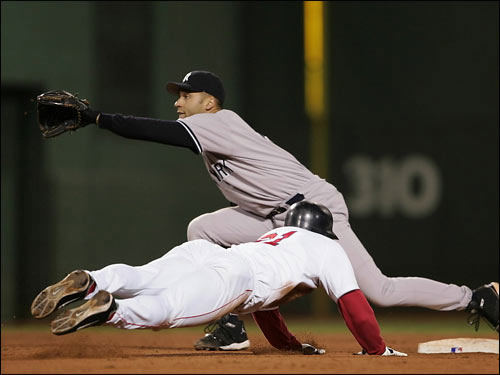
Of course, the tryout was a sham, and it only happened because of public pressure by Boston city councilman, Isadore Muchnik, who threatened to revoke the Red Sox’s permit to play Sunday games at Fenway Park unless the Red Sox offered a tryout to three black players. Those players were Marvin Williams, Sam Jethroe, and Jackie Robinson.

"The workout was supposed to be supervised by four Red Sox hall of famers," writes Jacobson in his new book, Carrying Jackie’s Torch. "Joe Cronin, the manager; 78 year-old Hugh Duffy, a coach; owner Tom Yawkey, a South Carolina lumberman;tom-yawkey.jpg and Eddie Collins, the general manager. Cronin refused to give an evaluation of the players he’d seen. Duffy said one workout wasn’t enough. Yawkey said any judgment had to come from his baseball people. And Collins said he couldn’t be there because of a previous engagement. Don’t call us, we’ll call you — and the Red Sox never did call."

It’s mind boggling that the Red Sox had "first dibs" on Jackie Robinson. Can you imagine how different Red Sox history would be — indeed, Boston history — if Jackie Robinson had played at Fenway from 1945 to 1956? Writes Jacobson: "The Red Sox, who won the American League pennant in 1946, the last year of the all-white major leagues, did not win another pennant until 1967. The effect was clear."

I didn’t know the whole story of Robinson’s bogus tryout with the Red Sox until Jacobson retold the tale. And when he was finished speaking, it was Bill Russell’s turn. I took notes of everything Russell said, and I’ve done my best to represent his words below.

"I’m proud to be here tonight, and I’m so glad the Red Sox are honoring Jackie Robinson on his 79th birthday. Anytime the Red Sox want me to be part of something honoring him, I’d be glad to do so, even though I live in Seattle and you can’t get here from there."

"I remember Jackie liked to bunt the ball down the first base line – that meant the pitcher would have to run over and field the ball as Jackie ran past, and Jackie was a football player…." Bill Russell smiled. "Slight collision!"

"The day after Jackie died, I got a call from Rachel Robinson, and she asked me to bbill-russell-2-2-1-08.jpge one of the pallbearers in Jackie’s funeral. And I asked her, ‘Rachel, why would you ask me?’ And she said, "Bill, you were Jackie’s favorite athlete.’ And when I hung up the phone, I remember thinking, How does a man get to be a hero to Jackie Robinson?"

"There were people along the way who tried to discourage me. But I lived a charmed life, because there were many people – black, white, Jewish, Christian – who pushed me forward, too. My high school basketball coach was one of those people. [Russell mentioned that Frank Robinson and Curt Flood attended his high school in Oakland at the same Russell was there.] He just looked at kids and saw baseball players or basketball players. And that’s what I encountered in Boston with Walter Brown and my coach – and my friend – Red Auerbach."

"Now I came to Boston believing I was the best player in the land. But I didn’t get along with my college coach [at University of San Francisco] for one single day – yet we managed to win 55 straight games and two straight NCAA championships. And my Olympic coach was from Tulsa, and we didn’t get along at all, either – but we won the gold medal. So when I came to Boston, I expected not to get along with the coach. But the first time I met Red, he said, ‘You’re among friends.’

"I was with a friend of mine in an airport and a stranger came up to me and said, You’re tall. Are you a basketball player? and I replied, No. Then another person came up to me and askbill-russell-and-red-auerbach.jpged, Are you a basketball player? And I said, Nope. So my friend asked me, Bill, why do you keep telling them no? And I told him, Because basketball is what I do, but it’s not who I am.

At one point, a woman stood and asked a question about what Bill Russell thought about urban kids all wanting to become athletes or entertainers, like the heroes they most admire. Bill’s response:

"I think it’s a myth that black kids today all just want to be athletes or entertainers. And my view is, we shouldn’t discourage kids from wanting to be special. I teach that we have to make changes inside-out rather than outside-in. I tell kids if you do work hard and use your intelligence, there are people who will give you a helping hand. But just giving help all the time [outside-in] can become a negative."

"I don’t see any problem with a kid wanting to be an athlete or an entertainer, and I reject that the only thing all these athletes are teaching kids is to be athletes and entertainers. That’s just not true. You know, almost all of the best players in the NBA have foundations and are doing a lot of work with kids in the community – almost all of the best players – and we rarely hear about that, but it’s true. And these players are teaching kids a lot more than how to be a professional athlete or entertainer."

Russell_ali_brown_jabbar "In schools across the country, physical education programs are being cut as budgets are slashed. And this is a big problem. P.E. programs aren’t about creating pro athletes, they’re about creating healthy people. In my case, I have a mild case of diabetes, and my doctor tells me that the only reason it’s not severe is because of the active life I led in my youth and young adulthood. Mind and body are both important in a child’s education."

"I remember the first time my mother said we could play in our front yard. Until that time, we had only been allowed to play in our back yard, but then one day my mother said we could play in the front. But she said to us, ‘Now people may walk by on the sidewalk, and some of them may say things to you. Some of the things they say may be good things, some of them may be bad. But whatever they say, don’t pay any attention to it. Remember, they don’t know you. And when they say bad things, that’s their problem, and they’re wrestling with their own demons.’ So, growing up, I was determined that no one would stop me. Particularly no one I didn’t know."

"My daughter was one of Professor Ogletree’s students [at Harvard Law School – Ogletree moderated the evening], and her mom and I went our separate ways when she was 12 years old. So there I was, a single parent with a 12 year-old girl, and to this day, it’s been the single greatest adventure of my life. And back when she was 12, I made two promises to my daughter: 1. I will love you ’til I die. 2. When you leave this house, you’ll be able to take care of yourself better than any many you’ll ever meet. And I told her that because I wanted her to feel the same way my parents made me feel. And that’s what I’m trying to do today with kids – to teach them to have confidence in themselves and not to be afraid. Jackie Robinson was never motivated by fear. He didn’t see obstacles, he onred-sox-retired-numbers.jpgly saw opportunities, and he saw every challenge as a chance to show what he could do."

"I’m looking forward to the next great baseball player, but I’ll tell you the truth, I don’t care what color he is."

The Red Sox will never shed the facts of the team’s racist history; but the birthday party at Fenway for Jackie Robinson, featuring Bill Russell — not to mention our two World Championship teams featuring players from a variety of cultural backgrounds – shows that those facts truly are history. History to be remembered, but never to be repeated.

The Meaning of the 2007 Patriots

Bruschi_and_vrabelI don’t buy it.

Everyone says the Patriots’ season became meaningless when they lost
the Super Bowl to the Giants. All the wins, all the records, all the
great feats of 2007 — up in smoke with one pass to Plaxico Burress.

But you know what? I don’t buy into that. And you don’t have to,
either. We live in a society that has decided to shower the "winners"
with a ridiculously disproportionate level of praise and credit and to
strip all value from every other competitor or team that didn’t reach
the mountaintop (where there’s only room for one). I don’t really know
why we’ve decided to see things that way, but I, for one, particularly
in this specific case, do not buy it.

Yes, the Giants won the Super Bowl. They are the Super Bowl
Champions. They are to be commended. They earned it. They deserve it.
They and their fans should feel awesome. The Patriots did not win the Super Bowl. But the Patriots of 2007 are still one of the greatest NFL teams of all time. And the 2007 Giants are not.

Now I hear you saying: "You can’t consider a team to be the best
ever if they didn’t win the championship – you fool!" But that’s only
true if we buy into what pop culture has driltom-brady.jpgled into us since you
were tiny tots crawling on the floor in front of Sunday afternoon
football games on TV. We have been taught since we were born that only the winner can feel proud, and that
every team or competitor that doesn’t win failed. And by God, if you don’t win the big game, well, you’re just a footnote and nothing more. LOSER!

But do you really believe that about the 2007 Patriots? Isn’t part of the
reason that it’s so hard for us to make sense of their Super Bowl loss
that there’s a deeper part of us that KNOWS they had a truly remarkable
season and that they were still — by far — the best football team in
the league this year — and THIS DECADE? And this deeper part of us
(I’m talking to you, Pats fans) knows they still deserve a parade in
Boston. And this deeper part of us ACHES to go to that parade and to
cheer for them for playing so incredibly well this year, for giving us
a feeling we’ve literally never had before with any team in Boston — a
complete, unassailable belief that we are invincible.

OK, so that feeling of invincibility ended up vanishing with less
than a minute left in the Super Bowl, but that feeling was still quite
a thrill, quite a gift to all of us in Patriots (and Red Sox) Nation.
And even in losing to the Giants, the Patriots played with a level of
effort that deserves our admiration. So they lost. Dowes-welker.jpges that mean we
abandon them? Is the only reason we loved them that they kept ending up
with more points than the other team when the game was over? Was that
really the only stinking reason?

No. For me, it was more than that. And maybe I didn’t realize that
fact until they lost to the Giants. Their wins were a reflection of
their beautiful excellence. And I loved them because of their beautiful
excellence. Before this season, I always thought of the
1986 Chicago Bears as the greatest NFL team ever. (They were 18-1 too.
But their loss came during the regular season, so we don’t hold it
against them.) But if I could pick one team in history to win one game
against ANY team, I would pick the 2007 Patriots (with a healthy Tom
Brady). And you know all the TV sportscasters WANT to say the same
thing (because deep down, they know it’s true), but they are afraid to
because they know they’ll get ridiculed (as I will) for praising a team that "lost
the big one." They’ll get ridiculed (as I will) for going against the code of our
society that says, "Only the winners of the Super Bowl can hold their
heads high." That’s just hogwash. And declaring it so helps me deal
with their loss. It relieves some of the pain. It sustains my
appreciation of the Patriots, and that feels good. (Try it!)

So, what’s the meaning of the 2007 Patriots? That you can still be
considered one of the greatest teams of all time and LOSE the big game.
That no team, no competitor is invincible. (When I yelled at the TV,
"Why did you miss that??" as Samuel dropped that potential interception on Manning’s final drive, my 8 year-old son said to me,
"Because he’s human, Daddy.") Trandy-moss.jpghat you can still be considered a
"winner" by fans and by commentators even if you come in second. And
that, if you choose to buy in to the "rule" that only one team and one
set of fans has the right to feel good at the end of the season —
well, that’s a rule that’s going to give you a lot of pain in your life.

Yeah,
I’m incredibly disappointed that the Patriots lost. Still stunned. A
little numb. No doubt, winning is better than losing. But I won’t line
up behind the people that want to just forget about them. The 2007 New
England Patriots were awesome. And one play with 0:35 seconds left
doesn’t eradicate an entire season of jaw-dropping performance. Unless
you decide that it does. But I just don’t buy it.

Bobby Knight Was My Catcher

catcher-pitcher-conference.jpgLast night I was interviewed on a local cable TV show called The Boston Baseball Heads Show.  We talked a little bit about Red Sox Nation, but what I enjoyed most was reminiscing about my years pitching in Boston’s Yawkey Amateur Baseball League, during the 1990s. The host of the show, Dave McKay, is the president of the league and a former manager of one of the teams I used to pitch against, McKay Club.

Even when I was a player on Avi Nelson Club, I hardly ever talked about the team or about playing baseball when I wasn’t at the park with my teammates. Why? No one else wanted to hear about my stupid baseball team. It just wasn’t interesting to anyone else. But man, I thought about pitching ALL THE TIME during those years, and I was obsessed with winning the championship (during my ten years, we never made it past the semi-finals). So it was such a pleasure to actually be ASKED by Dave McKay to talk about pitching and my memories of playing in the Yawkey League. And yet, the brevity of the interview left so many stories and memories untold. Hey, I guess that’s why blogs exist…

One of my favorite memories is of our catcher, Greg, and the things he said to me during our pitcher’s mound conferences. He only called time-out for these meetings when I’d mis-read one of his signals and throw the "wrong" pitch, or when I’d hit a batter on an 0-2 count, or when I’d walk a couple of batters in a row, or when I’d start talking back to players who tried to "rattle" me with trash talk. Greg would walk out to me slowly, and I’d start smiling, bracing myself for the next chapter in an almost comical pitcher-catcher relationship.

Now Greg was one of the older guys on the team. I was perhaps 25, and he was perhaps 38 (which was ancient to me). A little overweight, creaky knees, graying beard, balding. He’d played on lots of teams during his lifetime and somehow he’d hooked on with us. He’d lost some zip on his throws and his mighty swing wasn’t fluid anymore, but you could tell that he used to be great. Every now and then, he’d hit a home run that would make everyone’s jaw drop. And he’d just trot around the bases, expressionless, then walk back to the bench and start putting on his equipment, already focused on the next inning. He seemed to play baseball with a silent, personal vengeance.

bobby-knight.jpgWhen he arrived at the mound for a conference, Greg would remove his catcher’s mask and, in a very calm (but intense) voice, curse me out with all the venom of Bobby Knight. I’m sure everyone observing us had no idea of the thrashing I was receiving, partly because I had the expression of a person trying to hold back laughter. Greg was about a foot shorter than I, and he never looked me in the eye during his epic tirades. He either looked at my chest or let his eyes wander the field while every four-letter word ever invented spewed forth. At the end of his speeches, he DID look me in the eye and say something encouraging, like, "See this glove? Just throw to it." or, "Next pitch, fastball inside, and we’re out of this inning."

Funny thing is, I actually found Greg’s berating to be inspiring. Somehow, I knew that he respected me as a pitcher, had extremely high expectations for my performance, and really enjoyed catching me. I knew that his rude remarks were motivated by a deep passion for winning, and it felt awesome to have a teammate who was so driven. When he’d walk deliberately back to home plate, put his mask and glove back on, and crouch behind the batter, I knew that I’d execute perfectly my next pitch and that the batter was doomed.

Greg faded away from our team in the mid-’90s and I haven’t seen him since then. But when I was inducted into the Yawkey League Hall of Fame in 2003, he wrote me a nice email congratulating me on the honor. Of course, it was one of the most meaningful notes of congratulations that I received at that time. Although we had never been friends, we had collaborated intensely for a few years as "the battery" for those Avi Nelson Club teams, two totally different personalities sharing a passion for baseball and a deep desire to win.

http://www.box.net/static/flash/widget_player.swf

Get your own Box.net widget and share anywhere!

To download my song, I’m a Member of Red Sox Nation song for free, or to see the YouTube music video for this song, visit www.crawdaddycove.com.

Behind The Scenes at Fenway

yawkey-way-at-game-time.jpgLastweek, the Red Sox invited me to visit the team’s offices on Yawkey Way.
"Why don’t you come by around noon on Wednesday and sit in on a bunch
of meetings?" And so I did. Between noon and 4pm, I attended four
meetings:

1. A bi-weekly meeting of the team’s vice presidents and directors
(I counted 28 of them), led by team president, Larry Lucchino. Each
VP/director gave a brief update on his/her area of responsibility and
fielded a question or two from Lucchino. Even yours truly was asked to
say a few words. ("I don’t mean to put you on the spot, Rob," said Larry, "but what’s the state of the Nation?") 

2. A meeting led by senior vice president sales/marketing, Sam
Kennedy, to discuss the status of the Red Sox Fellows Program’s
recruiting efforts.

3. A meeting led by Sam Kennedy and director of client services,
Troup Parkinson, with executives from a company that currently spends
about a half-million dollars per year in advertising with the Red Sox.
The purpose of the meeting was to brainstorm ways to reconfigure the
deal going forward.

4. A meeting led by manager of community marketing, Mardi Fuller, on "Marketing to Women."

Rather than give you the blow by blow on these meetings, I thought
I’d share with you the most striking take-aways of my afternoon at
Fenway:

1. Larry Lucchino has the entire organization under his thumb, and
he seems to enjoy being president and getting involved in the details
of every aspect of the organization. He ran the VP/directors meeting
like an emcee, sprinkling in anecdotes from time to time, quizzing VPs
on facts about their area, and handing out praise generously. He is
clearly well-liked and highly respected by his charges.

2. Out of the 28 team VP/directors who spoke at that first mfenway-at-sunset.jpgeeting,
only two mentioned actual baseball players: Brian O’Halloran, director
of baseball operations (he attended in Theo Epstein’s stead), who gave
a brief update on minor transactions that had occurred in the last two
weeks, and **** Bresciani, the team’s historian and archivist, who gave
a spirited presentation about "this week in Red Sox history." As a fan,
it was striking to see that 95% of the meeting focused on issues that
would bore most fans to tears.

3. At lunch, following the VP/directors meeting, I had a chance to
talk with Ron Bumgarner, who runs the ticketing operation. "The Yankees
and every other pro sports organization laughs at us for the lengths we
go to to try to make tickets accessible to regular fans," he said. And
after 20 minutes of hearing about the thought process behind their
ticket operations, I believed him.

He confessed that sometimes the lengths to which the Sox go to make
things fair have a negative effect on their efforts to make the
experience easy. For example, when tickets are available online, some
people wait ten minutes to purchase tickets, while others who have
waited hours and hours and were "in line" first get nothing. He
explained that if the Sox did not pluck folks out of the "virtual
waiting room" randomly, the agencies/resellers would chew up all the
tickets ? because they have the manpower and, more importantly, the
programmer power to dominate the ?front of the line? and proactively
?mole? their computers to butt in the queue. He said that they could
sell out Fenway’s 81 games in one day if they wanted to, and that would
make their job easy, but they don’t do that because it would not be
fair to the "average fans."

4. I assumed that the Red Sox Fellows Program would cater to the
grandchildren of owners and nieces of senior vice presidents, but the
meeting on the Fellows Program made it clear to me that the Sox are
truly looking for a robust, diverse pool of applicants. Just as the
baseball operations people are looking for talented players, the
business operations people are looking for talented, capable "fellows"
to inject the organization with energy and to develop executives of the
future. (For more information on the Red Sox Fellows Program, click here. Applications for the 2008 season are due January 4, 2008.)

5. It was fascinating to me that 80% of the 90 minute-long meeting
with the corporate sponsor was spent "developing the relationship" —
talking about the 2007 season, catching up on how business is going,
talking about mutual friends and acquaintances. Only 20% of the time
was spent exploring the future of the company’s business relationship
with the Sox, and no actual financial terms of a deal were discussed.

6. The Red Sox have a gigantic "home field advantage" when meeting
with potential corporate sponsors at Fenway Park. Sam and Troup probably didn’t
notice the awe twinkling in the eyes of the three guest executives (two
of whom had flown in from D.C., and one from New York) as they walked
down the corridor to the conference room, gazing at the posters and
photos of Red Sox greats on the walls. What was perhaps ‘just another meeting’
for Sam and Troup was clearly one of the most exciting business
meetings of the year for their guests. When we sat down for the
meeting, a snow-covered Fenway Park loomed in the background through
the window wall. Even if you’re not a baseball fan, you can’t help
sprouting goosebumps in that room.

remy-and-orsillo-bobbleheads.jpg7.
One question that was raised at the "Marketing to Women" meeting was,
"With every game sold out and TV ratings high, and with a broader
female fan base than any other major league baseball team, why should
the Red Sox care about appealing to women more than they
already do?" The two big answers were: Because an organization that
appeals to women as well as men will thrive even when the team isn’t
winning, and because women represent half of the potential customer base/audience.

Other interesting points raised included: a) Women (and men) spend
more time directly experiencing the Red Sox through NESN (and their
team of Jerry Remy, Don Orsillo, and Tina Cervasio) than through
personal trips to Fenway Park. Therefore, any marketing efforts
targeting women need to examine the effectiveness of this channel. b)
Men (whom are the default targets of existing Red Sox marketing
efforts) have young daughters they want to bring to Fenway Park; they
have girlfriends and wives who sometimes accompany them when they
attend a game or watch on TV; and certainly "baseball" can compete with
all these women for "quality time" in the life of a male fan.
Therefore, the more broadly the team appeals to women, the more broadly
it will appeal to its default audience of men, as well.cubicles.jpg

8. In the end, the Red Sox offices are still offices where people go to work
every day (most are crammed into small cubicles), and the nature of
their work is not unlike the work done in other organizations: finance,
marketing, customer relations, sales, advertising, public relations,
etc. While all Red Sox employees have highly coveted jobs, they don’t
walk around exuding excitement and gratitude for their good luck; in
fact, I’d say they all looked pretty worn out after a long, strenuous
2007. (I assume the office atmosphere is slightly different in May,
during a Yankees homestand, the day after an Ortiz walk-off home run…)

I
want to thank the Red Sox organization for welcoming me into their
offices for a few hours. Their hospitality rates a ten out of ten, and
I appreciate their high hopes for the new roles of President and Vice
President of Red Sox Nation.